In short
Expanding into Malaysia and the GCC meant two new domains, and the obvious move was a separate website for each. With one person maintaining every site, three websites would mean three codebases, three sets of updates and constant drift between them.
Build the regions into the main site instead. Add /malaysia and /gcc routes to the existing website, point the regional domains at them, give each route its own design tokens from the regional brand guidelines, and add Malay and Arabic. One codebase, three regional experiences.
When a company expands into a new region, a website question shows up almost immediately: do we need a new site? For Concept Dash, expanding into Malaysia and the GCC raised exactly that, and the way we answered it saved a lot of ongoing work.
This follows the website rebuild, where we gave the main site a proper structure. This post is about what we did next with it.
The setup: two new regions, two new domains#
We registered a domain for each new region:
- conceptdash.ae for the GCC
- conceptdash.my for Malaysia
The main website stays at conceptdash.ca. So the starting point was three domains and three audiences.
The problem: more websites means more maintenance#
The obvious move is one website per domain. It sounds clean, and it is a trap.
Every website you add is a website you have to look after. Content changes, design fixes, security updates and deployments all multiply by three. We are a small team, and there are very few people to maintain websites. In practice, I am the one who does it.
Three separate sites would have meant maintaining websites forever, instead of improving them. And they would have drifted apart: one site updated, another forgotten, and a customer in one region seeing something out of date.
The fix: regions as routes on one site#
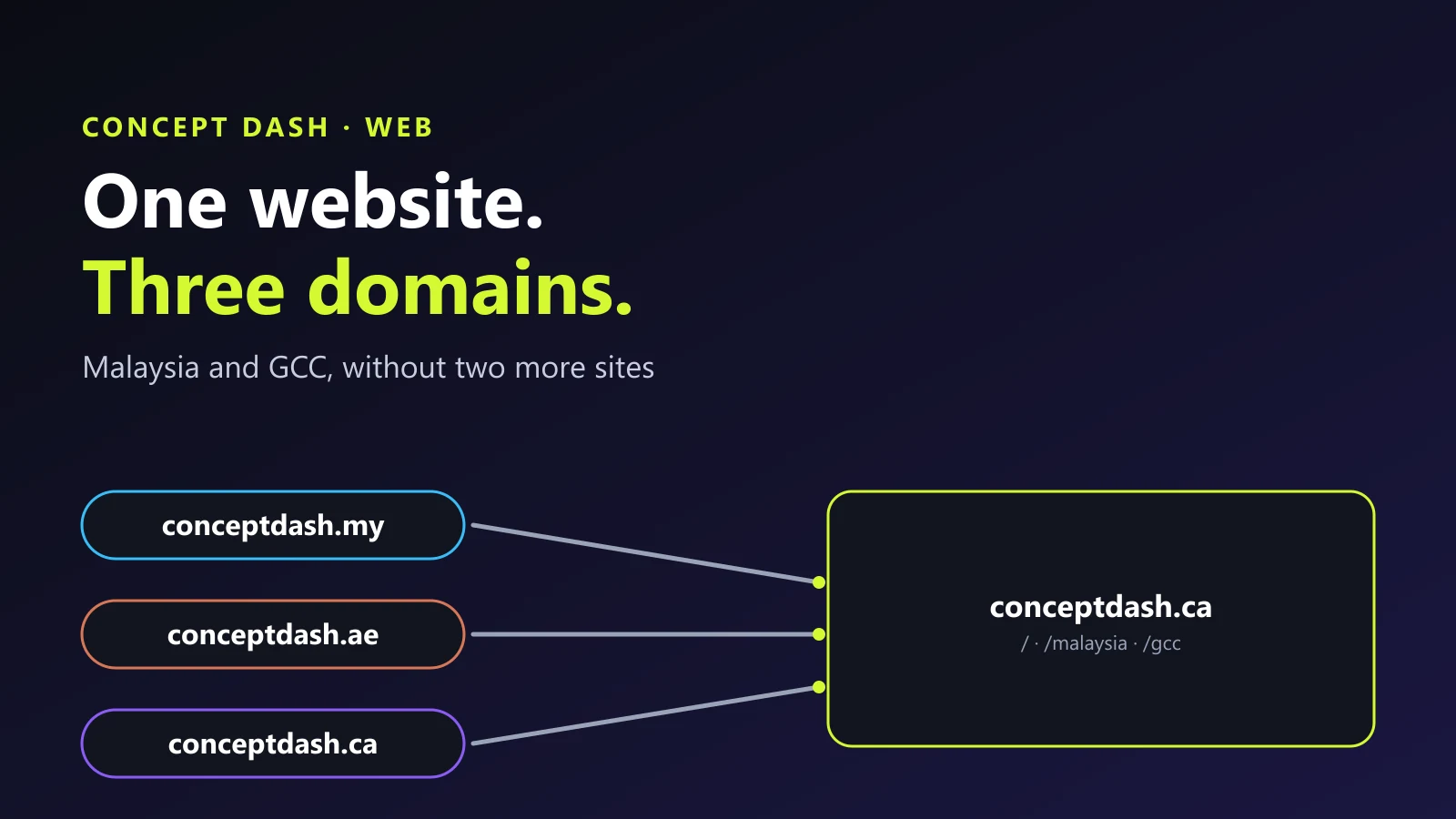
Instead of three sites, I built one site with regional routes.
Inside the main conceptdash.ca website, I added two routes:
- /malaysia
- /gcc
Then I pointed the regional domains at them. Typing conceptdash.my into a browser takes you to conceptdash.ca/malaysia, and conceptdash.ae takes you to the GCC route.
Making each region feel like its own brand#
A route on the same site must not look like the same site with a different heading. Each region has its own brand guidelines, so each route needed its own identity.
I handled that with design tokens: named values for colours, type and other style decisions. The site is styled from those tokens, so for each region I changed the tokens to match that region's brand guidelines. Then I gave each route a complete, proper look of its own.
The result is that a visitor to the Malaysia or GCC route sees a site that looks built for them, even though it runs on the same code as everything else.
Local language: Malay and Arabic#
The next requirement was local language.
- The Malaysia route supports Malay.
- The GCC route supports Arabic.
A visitor who types the GCC domain lands on a site in their own language, and nothing about it suggests it is a section of a larger website. It feels like the GCC website of Concept Dash, because for that visitor it is.
Why this works so well#
One update, three sites. Because all three are the same website, a change made once shows up for everyone. A new section, a fix or a content update goes live on the main site, Malaysia and the GCC at the same time.
Links that look separate. Our emails, newsletters and campaigns can link to the regional domains. Recipients land on a regional address and have no idea it is one website underneath.
Small team friendly. One codebase is something one person can look after properly.
| Three separate websites | One website, regional routes | |
|---|---|---|
| Codebases to maintain | Three | One |
| Updating content | Three times | Once |
| Risk of drift between regions | High | Low |
| Own brand per region | Yes | Yes, through design tokens |
| Local language | Yes | Yes |
| Regional domains in emails | Yes | Yes |
What to consider before copying this#
- Decide redirect vs rewrite on purpose, because it changes what visitors and search engines see.
- Label each language and region properly, so search engines can serve the right version to the right country.
- Keep the tokens disciplined. The approach works only if the whole site is styled from tokens, not from hard-coded values.
- Expect right-to-left work for Arabic.
- Know when to split. If a region ever needs very different features or a different team, a separate site may be right. Until then, one site is much cheaper to keep alive.
If your company is expanding into new regions and you want to avoid maintaining a pile of separate websites, share a short brief through the project form on this site and we can scope it together. You can also read about the website design and development service or browse more case studies.
- web-development
- web-design
- seo
Common questions
Why not build a separate website for each region?
Because every site you add is a site you have to maintain. With a small team, three codebases means three sets of updates, three deployments and a steady drift in content and design. One site with regional routes keeps all of that in one place.
What is a design token?
A named design value, such as a primary colour, a font or a corner radius. If the whole site is styled from tokens, you can give a region its own brand by swapping the token values instead of rewriting the styles.
How does a regional domain end up on the right page?
The domain is pointed at the main site and configured so a request for it lands on the matching route, for example conceptdash.my on /malaysia. Whether the browser's address bar then shows the new route or keeps the regional domain depends on whether you use a redirect or a rewrite.
Is this good for SEO?
It can be. Separate regional pages with proper language settings let search engines serve the right version to the right country. The details matter, so each version should declare its language and region, and the choice between redirect and rewrite should be made deliberately.
Do language versions need extra care?
Yes. Translation is only part of it. Arabic is written right to left, so the layout needs to work in that direction, and each language version needs its own correctly labelled pages.
Share this
One click opens LinkedIn with a ready-written post: a hook, the short version of this guide and the link. The caption is also copied, so you can paste it if it does not appear.
Instagram has no web share link, so this gives you both pieces: copy the caption, save the card, then post it.
This shipped as
Concept Dash company website
Client Websites
Keep reading
How We Rebuilt the Concept Dash Website for Clarity and SEO (A Before-and-After Case Study)
A case study on rebuilding a company website that lagged, had no clear structure and no SEO: expertise pages with their own URLs, optimised images, a new landing page, two sister sites and a 3D showcase.
10 Next.js SEO Tips for Developers
Ten Next.js SEO tips: metadata, sitemaps, canonical URLs, structured data, image optimisation and avoiding the 'crawled, currently not indexed' trap.
Website Design vs Website Development: What's the Difference?
Website design is how a site looks and feels; website development is how it works. Learn the difference, who does what, and which one your business needs.
Got this problem too?
Websites, web apps and SaaS products in React and Next.js, with the backend, payments and integrations they need to actually run a business.