In short
Owners often live with a website that quietly underperforms because nothing is obviously broken, so they never decide a redesign is worth it.
A redesign is worth considering when the site is slow, hard to use on mobile, outdated, unclear, unable to be updated easily, or no longer produces enquiries.
You probably need a website redesign if visitors cannot tell what you do, the site is slow or awkward on a phone, or it no longer brings in enquiries. These ten signs help you decide between small fixes and a proper rebuild.
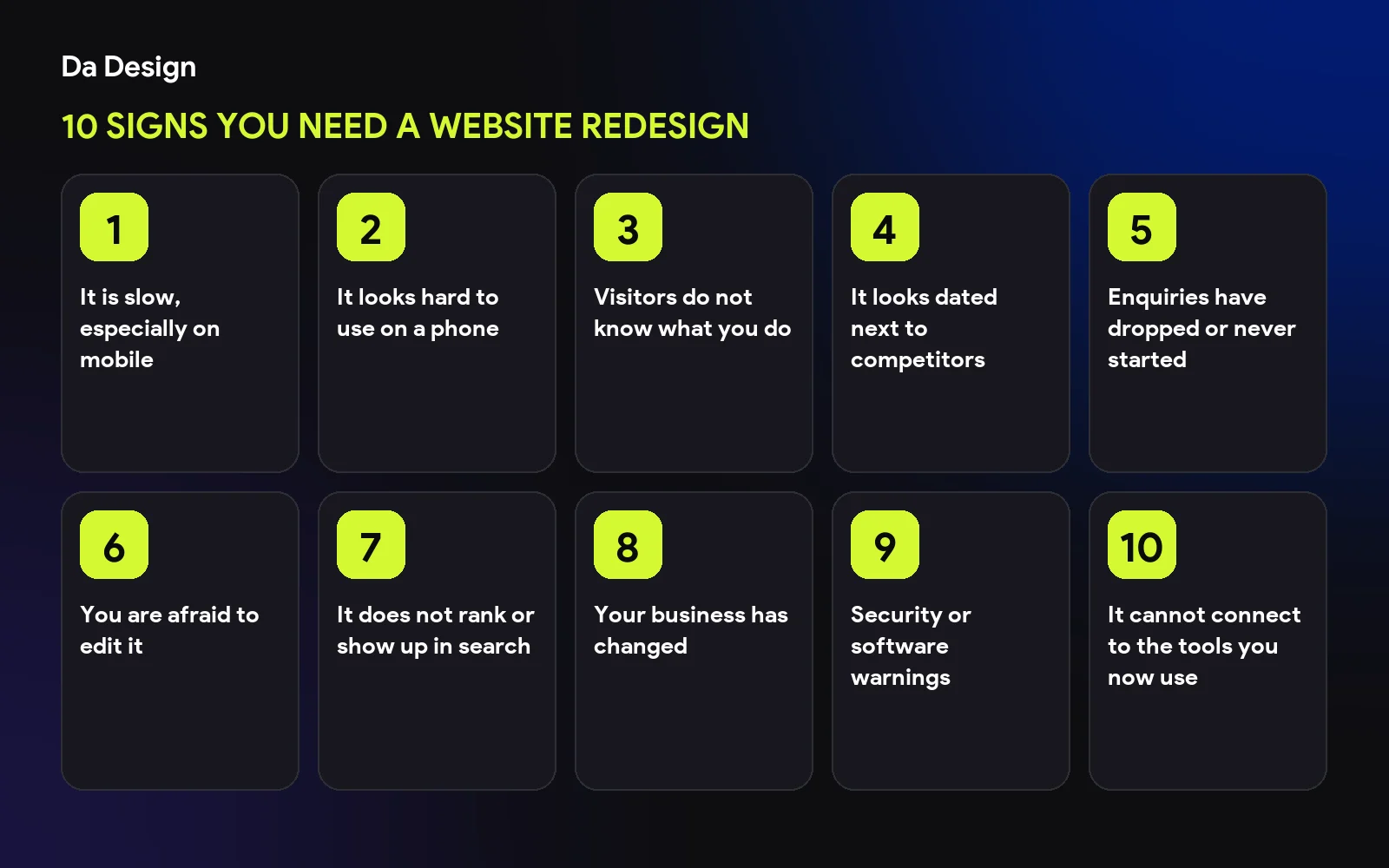
It is slow, especially on mobile#
If pages take several seconds to appear on a phone, visitors leave. Speed problems that come from the foundation of the site are hard to patch.
It looks hard to use on a phone#
Tiny text, overlapping elements and menus you have to pinch to open are signs the site was not built mobile-first.
Visitors do not know what you do#
If the homepage does not say what you do, who it is for and what to do next within seconds, the message needs rebuilding. See how to design a website that gets more leads.
It looks dated next to competitors#
Design is a trust signal. An old-looking site can make a good business look inactive.
Enquiries have dropped or never started#
Traffic without enquiries often points to unclear messaging or a weak call to action, not a lack of visitors.
You are afraid to edit it#
If changing a phone number or price needs a developer for hours, the site is costing you time.
It does not rank or show up in search#
Missing page titles, thin content and poor structure hold back search visibility. A rebuild can fix the structure properly.
Your business has changed#
New services, new audience or a new brand direction mean the site describes a business that no longer exists.
Security or software warnings#
Outdated plugins, browser warnings or a missing padlock damage trust and can put customer data at risk.
It cannot connect to the tools you now use#
If you need bookings, payments, a CRM or automation and the site cannot support them, a rebuild may be cheaper than workarounds.
save this checklist
- Test the site on a real phone
- List what you would keep
- Set one goal for the new site
- Plan redirects for old URLs
- Agree who edits content
What to do next#
If three or more of these apply, plan a redesign: keep the content that works, redirect old URLs and set a clear goal for the new site. Read the Concept Dash redesign case study for a real before-and-after.
- website-redesign
- web-design
- conversion
- small-business
Common questions
How often should a business website be redesigned?
There is no fixed schedule. Redesign when the site stops supporting your goals, not because of a calendar. Many businesses revisit it every few years.
Will a redesign hurt my SEO?
It can if URLs change without redirects or content is removed carelessly. A planned redesign keeps good content and redirects old URLs, and it can improve SEO.
Redesign or small fixes?
If the problems are a few pages or a slow image, fix them. If the structure, platform or message is wrong across the site, a redesign is more efficient.
Share this
One click opens LinkedIn with a ready-written post: a hook, the short version of this guide and the link. The caption is also copied, so you can paste it if it does not appear.
Instagram has no web share link, so this gives you both pieces: copy the caption, save the card, then post it.
Keep reading
10 Things Every Small Business Website Needs
A practical checklist of the 10 essentials every small business website needs, from a clear headline and mobile design to trust signals, SEO basics and a working contact path.
10 Landing Page Elements That Increase Conversions
Ten landing page elements that help turn visitors into leads: headline, proof, clear offer, simple form, speed and a focused call to action.
How to Design a Website That Gets More Leads
Practical website design principles for lead generation: clear messaging, strong calls to action, short forms, trust proof, speed and testing that turn visitors into enquiries.
Got this problem too?
Websites, web apps and SaaS products in React and Next.js, with the backend, payments and integrations they need to actually run a business.